Affichage des articles dont le libellé est All recipes. Afficher tous les articles

vendredi 16 janvier 2009

Hot Clear Vegetarian Borscht


I know! I know I have a soup problem, okay! I admit that I did make borscht. An entire pot full of delicious borscht. Wilfully, with full knowledge of the consequences and, as Lord Melchett so damningly said, with beastliness of forethought.

I HAVE NO REGRETS.

I used this recipe for clear, vegetarian borscht. I made a few modifications: I didn't have beet greens, which didn't seem to matter. I also didn't add sugar (I can almost never bring myself to add sugar to savoury dishes.) This soup is simple but beware underseasoning - beets love salt and pepper and they need a lot of both to shine in this soup.

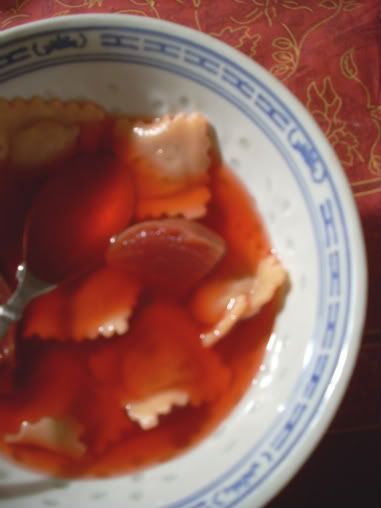
I was nervous about it, but it turned out just like the version made by our polish family friends for christmas eve! Which is the ultimate benchmark, let me tell you. The polish christmas eve is traditionally vegetarian (though I'm even MORE vegetarian because apparently the polish consider fish a vegetable.) This borscht, to me, should always be served very hot with some kind of dumpling or pasta in it. I love uzka, the polish pig-ear-shaped mushroom dumplings, and so I had mine with some fresh mushroom ravioli from the market at Dupleix.

I served mine with some of the cut up beets still in it, to make it a more substantial meal and to get some of the nutrition and fibre left in the beets. I did not put any sour cream in it. It doesn't need it! Stop complicating your simple and delicious borscht with your sour cream ways. That's not how we roll on polish christmas eve, and that, as you know now, is the ultimate benchmark.


mardi 13 janvier 2009

Attempts at Zucchini Fritters


Since last sunday I have had zucchini fritters on my mind and I couldn't stop thinking about them. I even bought corn starch so I could make them (buying an ingredient for one recipe is positively decadent on a student budget - then again a lot of asian sauces use it too so I rationalised that it was acceptable). In my quest for fritters, I have attempted twice now to make the Chez Panisse zucchini fritters. The first time I adapted them by adding mint and feta and omitting the lemon zest and chives. They were good; very moist and fresh and fragrant, but a little too soft. The grated zucchini just gives off way too much moisture even after you salt and squeeze it.

So the second time I made it as the recipe says, but added some flour until the batter was a little firmer. It improved it a bit, but the softness remained. The fritters are actually very tasty. The issue is not so much with the recipe, but with the craving I had and the idea I got fixed on - I definitely want a chewier, almost tougher fritter. I don't think a fritter based on grated zucchini is going to do the trick.

The only other thing I can think to do is sauté chunks of zucchini first and put them with a doughier batter. But I don’t want to stray into texas fair food unintentionally (straying there intentionally is a whole different story). I guess the file on this has to stay open for now.

vendredi 28 novembre 2008

Cheating Noodle Soup


I know I make a lot of soup, but it's winter, so cut me some slack. I make this soup whenever I eat too much afternoon tea. This is often. Sometimes I go to Sadaharu Aoki for a lemon tart and then they're offering free tastings of chocolate coated macaroons, so I taste the three flavours, and then I get curious about the other flavours, and they're so reasonably priced, and then suddenly dinner seems pretty much unjustafiable.

And yet there is no protein in those macarons, and vitamins are thin on the ground. So a delicious, light, extremely healthy dinner is sometimes the only course of action.

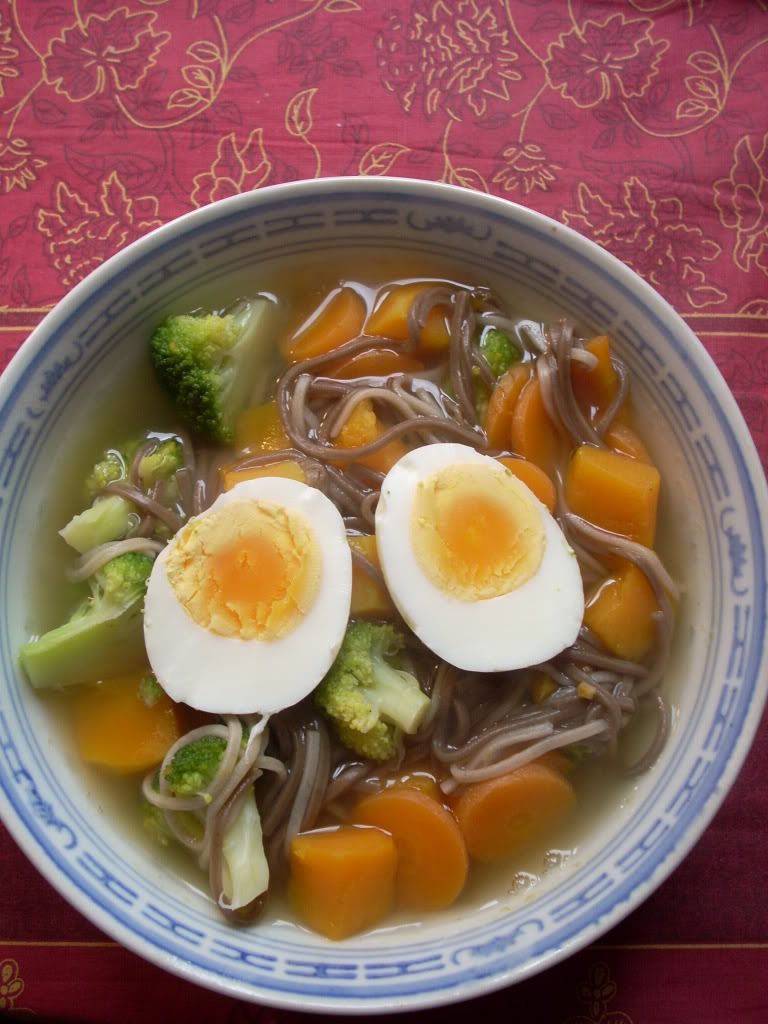
This soup is so damn easy I hesitate to call it a recipe. I am of the Bittman school of soup recipes, which believes that soup is basically water and vegetables. All you do is boil up some vegetable stock with a few dashes of soy sauce, then throw in chopped carrots. After a few minutes add some buckwheat soba noodles and any other medium-cooking-time vegetable (this time I added the second-to-last serving I am likely to get out of my beloved butternut). When the noodles are almost done, throw in a big helping of broccoli florets. When they're cooked, the soup is ready. The carrots and broccoli are a must because they turn the boring stock base into a really rich broth, and this is a great way to eat these vegetables without chucking the water down the sink (and with it all the vitamins and half the flavour).

I like to top it with a boiled egg just so that it looks like some kind of effort went into preparing the soup. I'm not sure why I continue with this obvious charade, since I am the only witness to my culinary cheating, but frankly it makes me feel better about the whole thing.

vendredi 21 novembre 2008

Eat your goddamn vegetables (in a pie)

Vegetables. Damn, I love them. I feel so smug when I read nutritionists advising people to eat more vegetables. It wouldn't be physically possible for me to eat more vegetables. I'm like some kind of voluntary foie gras duck when it comes to vegetables. I apologise for that cruel and unusual visual.


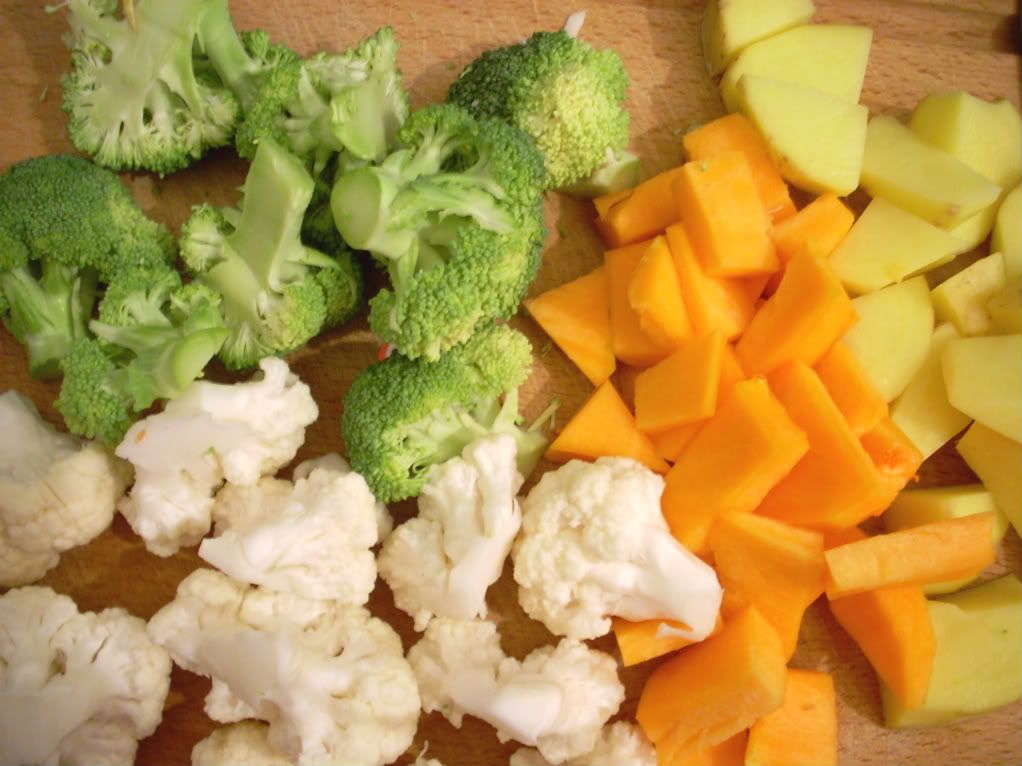
This bake is a good way to eat lots of different vegetables. And it's healthy because though it has mozarella in it, it also has five different types of vegetables plus kidney beans. And that's pretty much it, so I guess it's also extremely easy. This is my recipe (it evolved from an ancient recipe for a brown lentil and cauliflower bake) which I always do slightly differently every time I make it, so don't bother following it too closely. You could use almost any vegetables - sweet potato, parsnip, carrots and swedes are some I've used successfully in the past. I almost always use broccoli though because it is so delicious with mozarella.

Ingredients (amounts as given make 3 medium servings)

1 medium tin of red kidney beans or equivalent dried
1.5 cups chopped cauliflower
1.5 cups chopped broccoli
1/2 a cup potato cut into cubes
1/2 a cup of butternut cut into cubes
About 3/4 cup of buffallo mozarella
3-4 tablespoons of plain or greek yoghurt
dried coriander to taste
dried cumin to taste
chopped fresh parsley to taste (at least half a cup, come on, it's so delicious)
salt, pepper to taste

1. Put the beans in a saucepan with coriander, cumin, salt and pepper. Let simmer gently while you do the rest of the recipe. If you used dried and soaked beans you need to do this for at least an hour, as I am sure you know.
2. In a large pot of water, add the potato, then the butternut. When they're about half done, add the cauliflower and broccoli. Let cook until they're soft but not falling apart.
3. Drain the vegetables and then partially mash them roughly with a fork, adding the yoghurt and half or 2/3 of the mozarella (cubed or torn as you like). Season with salt and pepper to taste, then add the parsley. I added at least a cup because I love parsley.
4. In a pie dish or what have you, put down about an inch thick layer of the thick vegetable mash. Then drain the beans of excess water and put down a layer of beans. Then top with the rest of the vegetable mash.
5. Take the rest of the mozarella, torn up into little bits, and sprinkle it evenly over the top of the vegetables.
6. Bake in the oven or in your sad student-flat microwave with the grill on until the top gets brown. I dont have an oven, so I can't give you an actual temperature. I use aforementioned sad microwave and I use the highest setting on the feeble imitation of a grill element. It doesn't really matter since everything is cooked already, you're just getting all the flavours to mix into each other and making the cheesy top all golden and delicious.

mercredi 19 novembre 2008

My friends the red aduki beans


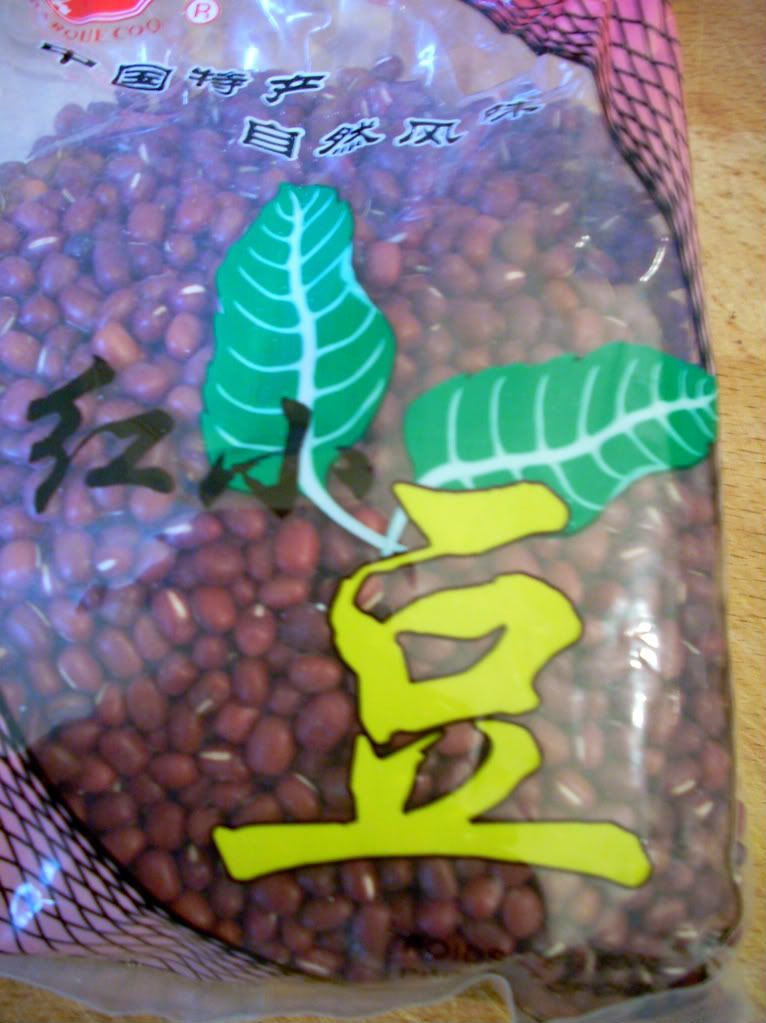
Red beans, or Aduki beans, are unusually high in protein and low in fat even as beans go. They're also very high in calories, but nobody cares, because they are delicious. My experience of these beans is mostly in the form of sweet red bean paste, which I have eaten in buns, in motchi balls, and on matcha ice cream. They are also used in savoury dishes, but I'm not really interested in that because they're so outstandingly delicious in a sweet paste that I can't move on from it.

I made a sweet chunky red bean paste as my first foray into cooking these myself, and it was very easy. You just soak the beans overnight, then boil them until they're very soft, and then mash them up, and then add sugar to taste. I used brown sugar even though I am sure most recipes call for white.

I was going to make red bean crepes, but the morning was too crushed for time. I decided to have oatmeal instead, and so I discovered that stirring in two or three spoonfulls of the red bean paste to oats porridge just before it is finished cooking is amazingly delicious. It also sweetens the porridge so you don't need to put extra sugar or honey on it, so you can convince yourself that you're being somewhat healthy. Maybe.

samedi 15 novembre 2008

Butternut soup with toasted pumpkin seeds and sage butter

I bought a butternut at Tang Freres this week. Never having dealt with an entire butternut before - I used to have my dad do this kind of scary stuff - I was a little nervous. But I dispatched it pretty well after a few minutes of hacking and cursing. So now I had all the butternut I could want, and the next step was obvious: soup.


I decided to work off Pim's recipe for Potimarron soup with sage butter but as I don't have an oven, and as I hate washing up, I decided to see if I could do it in one pot. This is roughly how it happened and it served one (me).

Sautee about half a very little yellow onion until it has caramelized, then put it on a plate and set it aside. Then in the same saucepan, boil about a cup and a half of chopped butternut in just enough water to cover it. A little while later throw in about 3/4 of a cup of white beans (if you use canned you can just throw them in here, if you used dried you need to precook them like I do. Use dried! They're infinitely better.) Leave that to boil for about ten minutes, then mash it up and let it stand.

While it is standing, turn your attention to the sage butter. I didn't have sage leaves, so I just melted some butter with some dried sage in it in a little saucepan (thus ending the one-pot dream). This was delicious in the soup in the end, although I can't say whether it measures up to proper sage butter because I have never had it. I left the sage butter to the side and went back to the soup.

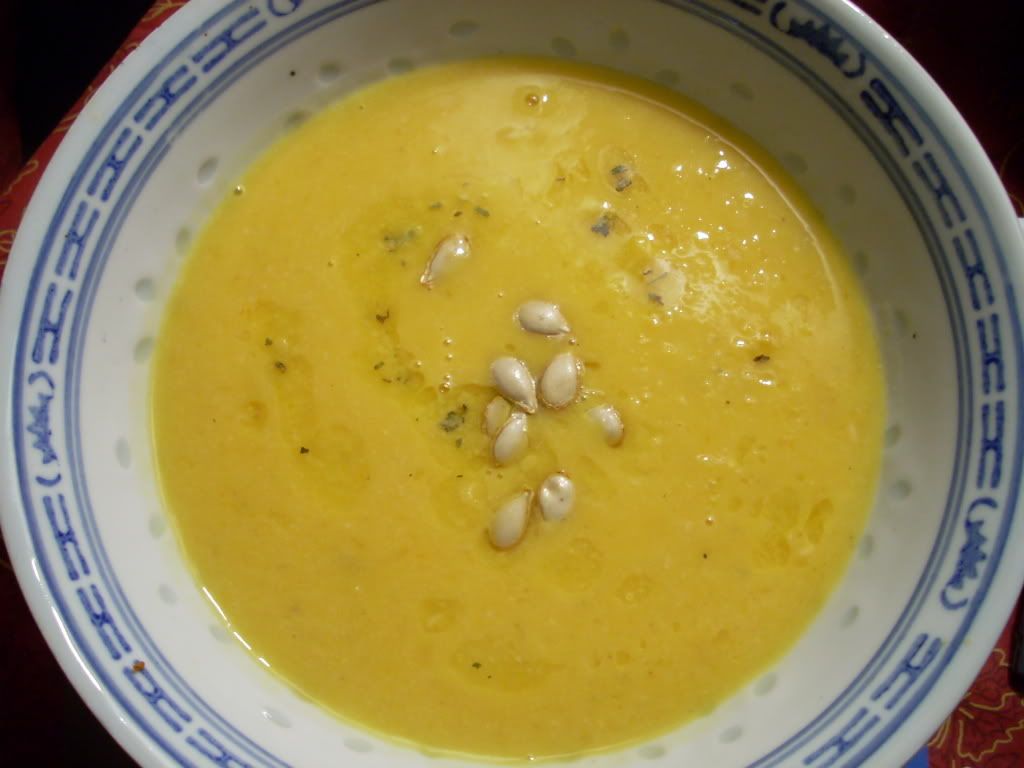
Add some milk until it is the thickness you want, then added the onion back in. Puree the whole thing with an immersion blender (or in a traditional blender if you swing that way). When it goes back on the heat, add a tablespoon of greek yoghurt or creme fraiche. Now it needs to be stirred constantly otherwise the bottom will burn. When it comes back to the boil, it's done. You can put on as much sage butter as you like, I used about a teaspoon for my single serving, as well as some toasted pumpkin seeds.

Toasted pumpkin seeds are very easy to do in a skillet or pan, since they announce when they are done by popping and cracking and generally being a nuisance. Then it's just a matter of throwing some fleur de sel or kosher salt on them and drizzling them with olive oil.

I think the caramelised onion goes so well with the butternut, and the sage butter is so much nicer than just adding sage right to the soup. This is really outstandingly delicious, and I had it with Poujauran's delicious sourdough bread.

dimanche 2 novembre 2008

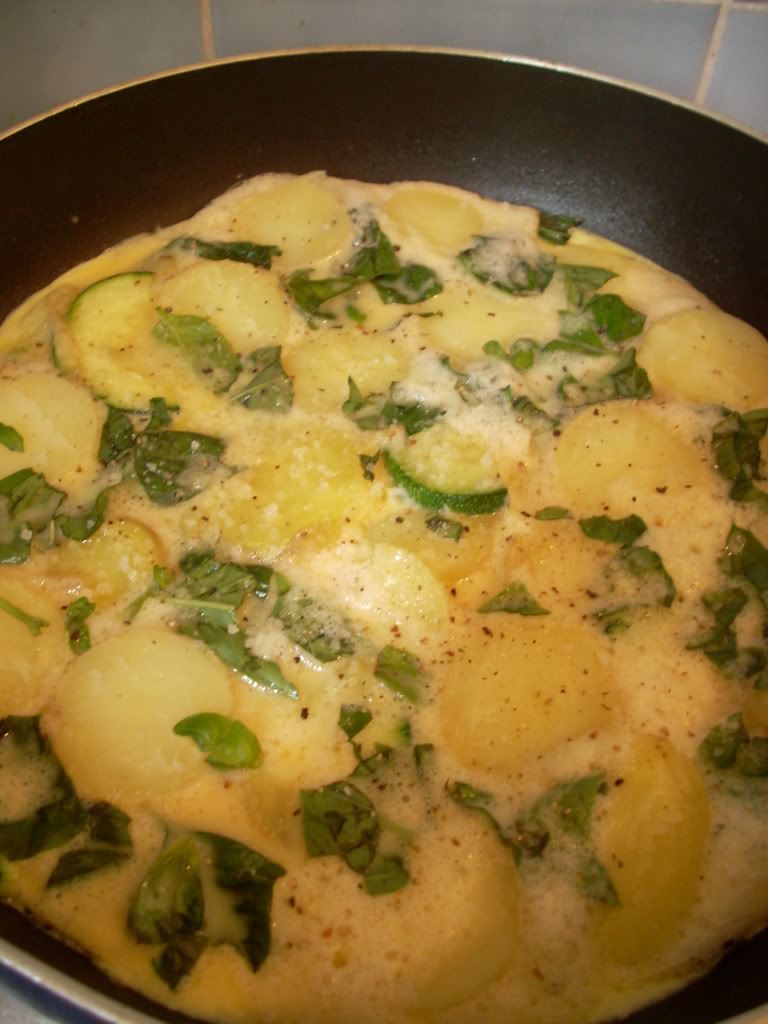
Potato, Zucchini and Basil Frittata


I have never made a frittata before because most recipes call for them to be finished under a broiler. I don’t have an oven, ergo I don’t have a broiler. However, I was very glad to learn that the traditional way to make a frittata – and its Spanish older brother the tortilla – does not involve a broiler. Broilers are for sissy wimps. Real women use plates to flip the tortilla and cook it using only a frying pan. And I have a frying pan, so I went to it.

This is my recipe; again it’s based on many I have seen around. Most add cheese, some even add flour and baking soda, which I am sure is another way to sissify the tortilla. I’m afraid mine isn’t truly Spanish. But it does taste great.

Ingredients
4 small fingerling potatoes, cooked
1 small zucchini
3 eggs
¼ cup of milk
fresh basil, salt and pepper to taste
olive oil

1. Slice the fingerling potatoes into rounds. Slice the zucchini into rounds, salt and let stand for 30 minutes (either in a colander or on a plate – if you choose a plate then you may need to blot the zucchini to get the water to really come out).
2. Heat up some olive oil in a pan. While it’s heating, separate the eggs and whisk the whites until they fluff up (but you don’t want it stiff, just fluffy). Mix the milk with the yolks. Continuing to whisk the whites, pour the yolk mix into them in a steady stream.
3. Sautee the zucchini. Add the potatoes, seasoning as you go. When the mixture is nearly done, add the basil and stir it in. Arrange the vegetables so they are roughly in layers then pour the egg mixture over and turn the heat down to medium.
4. Let cook for a while, until it is fairly solid and when you lift up the side with a spatula you can see it is golden brown on the bottom.
5. Slide the tortilla out onto a plate, then put the pan on top and invert in one confident swoop (I think the confidence is the key – the frittata will know if you are a sissy or not and will respond accordingly).
6. Depending on how crispy you want it you can let it cook for another 3-8 minutes. This is a small tortilla and serves 2-3.

As you can see I used a really deep pan so I couldn’t get the damn thing to slide out without compromising the structural integrity of my lunch. I had to do a double inversion – flipped it once onto a plate to get it out of the pan, but then it was the wrong side up, so I inverted it again between two plates, and then finally back into the pan. It worked fine – it didn’t drip or slide around at all. Clearly, I am no sissy.

samedi 1 novembre 2008

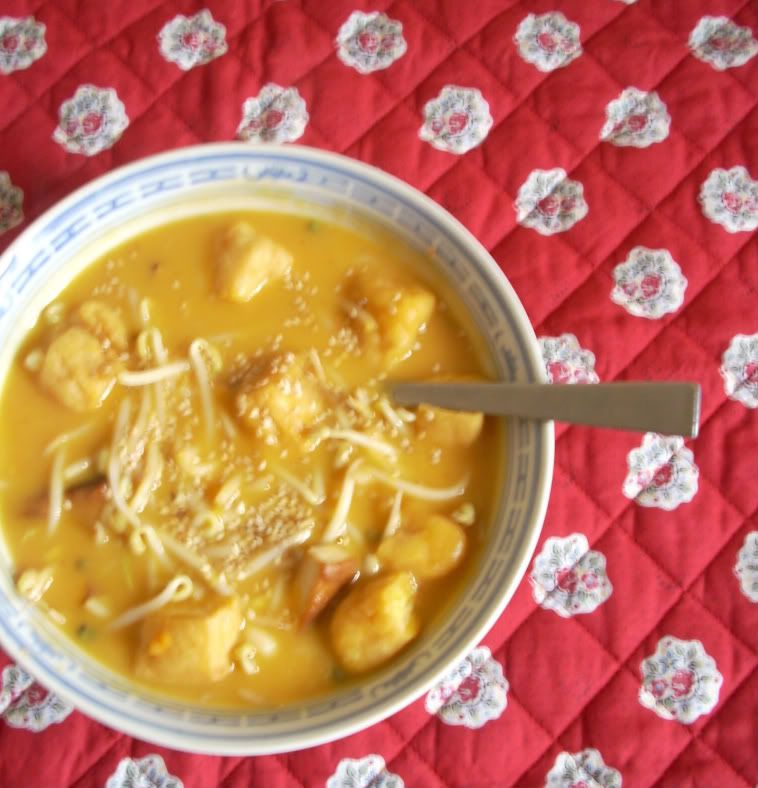
Coconut Ginger Sweet Potato Soup


Once again, this is a recipe which is my riff on several that I saw around the internet. The internet seems to think this is a "Thai" sweet potato soup. I'm not so confident. The extent of its Thai-ness is probably just that it uses thai red curry paste, ginger and coconut milk, all of which are abundant in Thailand.

This recipe is so easy it borders on the biblical sin of sloth. All you need is sweet potato, coconut milk, thai red curry paste, vegetable stock, chopped ginger and toasted sesame seeds. How much you use of each of these ingredients is up to you. In general half a large sweet potato serves one person. I like about a 1 cm cube of ginger and 2 teaspoons of red curry for each half sweet potato, but I like it hot, if I can say so without inducing snickering.

Chop the sweet potato up into very small cubes - the smaller the better, since they cook faster and are easier to blend later. Put them in a pot and just cover them with stock, then add the curry paste and chopped ginger and boil it until it's very tender. You should be able to squash the peices into a pulp with a wooden spoon on the side of the pot.

Take it off the heat and let it cool. Mash it up as much as you can before you blend it, so you can see if you should drain off or add some stock now. This step is doubly important if you use a hand-held blender like I do, because they get tired and grumpy after about a minute of use. I tend to add more stock as I blend since I invariably get my amounts wrong in stage one.

Once it's smooth, put it back on the heat and add coconut milk to taste. If I feel greedy I add 1/4 cup to my single serving, though, sometimes just a splash is enough. It's the interaction between the coconut and the heat of the ginger and chilli in the paste that makes this great. Bring it to the boil again and then serve it hot with toasted sesame seeds on top.

I always add bean sprouts and some cubes of firm tofu, which makes this soup a meal. I generally pan fry the tofu beforehand in some sesame oil to give it a little more personality. This time I also added puff tofu and udon noodles, which need to cook in the soup for a little while, so add them when you add the coconut milk. Fresh coriander also works wonders in there.

lundi 27 octobre 2008

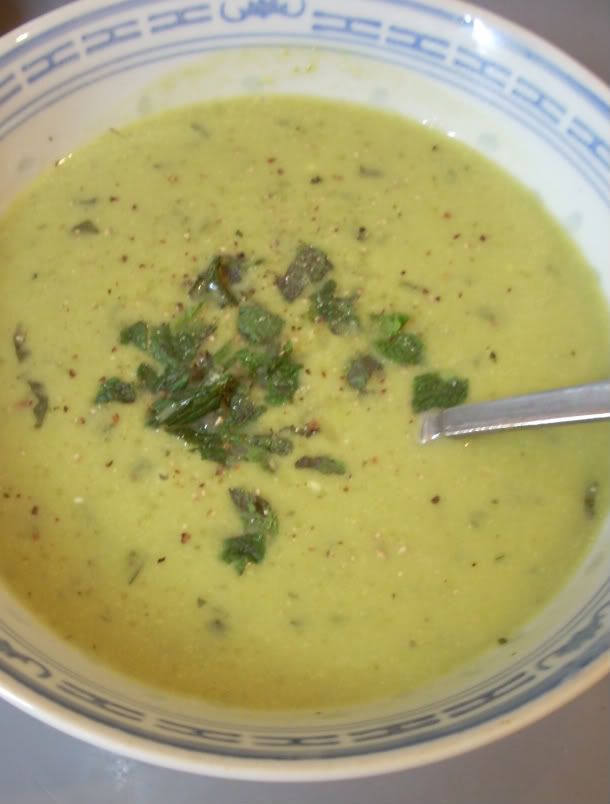
Pea, Mint and White Bean Soup


I love pea and mint soup, and white beans add not only protein but also a subtle, brothy flavour, so I thought combining them might work well. This is my recipe, which I formulated after reading about twelve different recipes for pea and mint soup until I had the general idea, and then forging ahead on my own.

Ingredients
2-3 cups of cooked white beans
3 cups frozen peas
Vegetable stock as needed
Chopped mint to taste - at least half a cup
1/2 a cup of greek yoghurt
Salt
Pepper

1. The white beans need to be boiled until tender. In the pot and water in which you cooked the white beans, add the frozen peas and enough stock to cover. It's important to conserve the white bean water because it has a lovely subtle flavour. Add a little mint now just to get it going. Bring to the boil and simmer until the peas are tender but not mushy.

2. Remove from heat and let cool for a while, so that you don't overheat your blender when you blend it. Puree with a hand blender until smooth, adding more stock if you want it to be thinner. Obviously this will work in a traditional blender too.

3. Return the soup to the stove, and add the yoghurt, salt and pepper and mint to taste. In my opinion this much soup needs at least half a cup of chopped mint. I probably put in more like a cup. Similarly the seasoning here is extremely important. Peas are a vegetable that make their objections known if you underseason them, and they will make these objections known on your palate. If you taste the soup and it tastes anything short of incredible, add more salt and pepper.

4. Now that the soup tastes incredible, bring it back to a simmer, and then serve it hot in winter or cold in summer.

I don't think this kind of soup should be eaten with bread, because it clouds what should otherwise be a really clean flavour. But that's just me, I'm sure the rest of you aren't so bizaare in your soup beliefs.

(This recipe is my entry for this month's Legume Love Affair. Check out the details here, at this month's host blog When My Soup Came Alive.)

samedi 25 octobre 2008

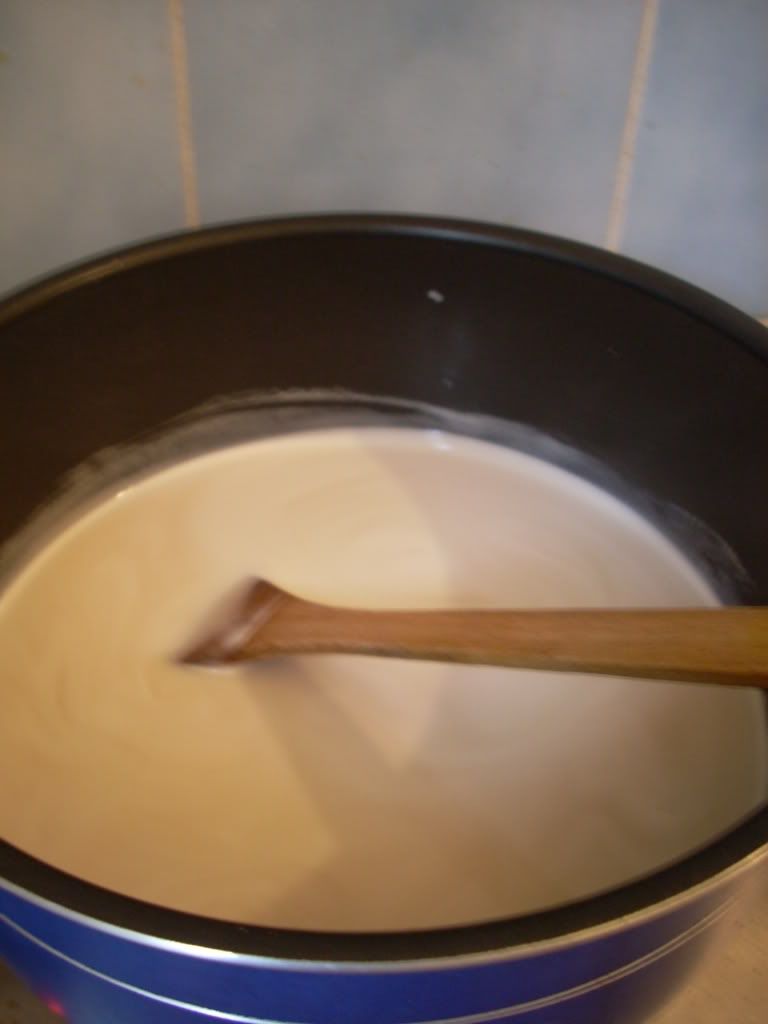
Making Dulce De Leche

Generally I like things I can taste as I'm going, I like being fast and loose with ingredients and I don't like to measure them. So Dulce de Leche is really pretty far outside my usual repertoire. But I love it, and since I needed to come up with a gluten free dessert for lunch with some friends, I decided now was the time to make it.

Most recipes online ask you to boil a can of condensed milk. However, I only have a microwave oven, and since I also have the will to live, that option was not open to me. I had a look around online and ended up getting a general feel for what was supposed to be going on. Here's how I did mine. This makes a very small batch, since I didnt want to have too much left over from dessert.

Pour 1 litre of full cream milk, 250 g of brown sugar and 1 teaspoon of salt into a large, deep pot.


Stir constantly on a medium heat until the sugar has dissolved. Continuing to stir, turn the heat up to high and let the mixture boil so that it froths up. Then turn the heat down to a medium low. Most recipes say the mixture shoud be barely simmering, but I got very paranoid and turned it down a little too low - the mixture was only occasionally bubbling. That's why this batch took about 4 hours to reduce down to a consistency I liked. Apparently you can leave the mix alone, but I got up every 30 minutes or so to gently whisk it just to prevent a skin from forming (do you see what I mean about paranoid?)

About 3 hours in, the taste was similar to condensed milk, which worried me - the dulce de leche I remembered is in the same family of flavours as condensed milk, but it certainly isn't the same flavour. It seemed to have the same aftertaste too, and I hate bad aftertastes. But if you keep reducing it it will eventually lose this taste. You can add a pinch more salt if you're worried (I did and I liked it).

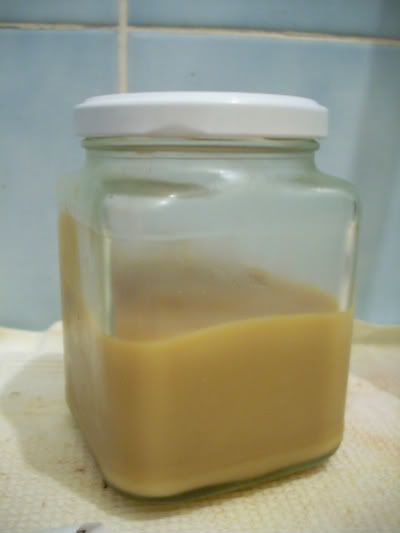
When the batch is the consistency you want - and remember it firms up quite a lot more when you cool it down - whisk it to make sure it is smooth and then pour it into containers to cool. When I took it off the heat the consisency was such that it would drip off a spoon slowly. After 5 hours of refrigeration, when I dug a spoon into the jar the shape of the dig stayed clean in the caramel.

I whisked a little cinnamon into half the batch and found that it worked very well with it. This is really easy to make - I think the most difficult part is not eating it all as soon as it's finished. I know I kept "checking the consistency" with a spoon throughout the day, and then - surprise! - I had a spoon with dulce de leche on it I just couldn't waste! At lunchtime we had it with vanilla ice cream and sauteed pears and it was great.

mardi 21 octobre 2008

Dinner tonight: Pim from ChezPim's greek eggplant tomato sauce

I have been wanting to make Pim's greek eggplant sauce for a while, but slender eggplants are a bit hard to come by in Paris supermarkets. So today when I saw the Franprix was carrying graffiti eggplants, which are in between the long thin asian ones and the big round western ones, I decided the time had come. It was also a happy coincidence that The Spice Cafe's monthly challenge involved making sauces with other bloggers' recipes. You can check out the details at Tangerine's Kitchen, the host blog, here.

The sauce turned out really amazing even though I made some major adjustments.

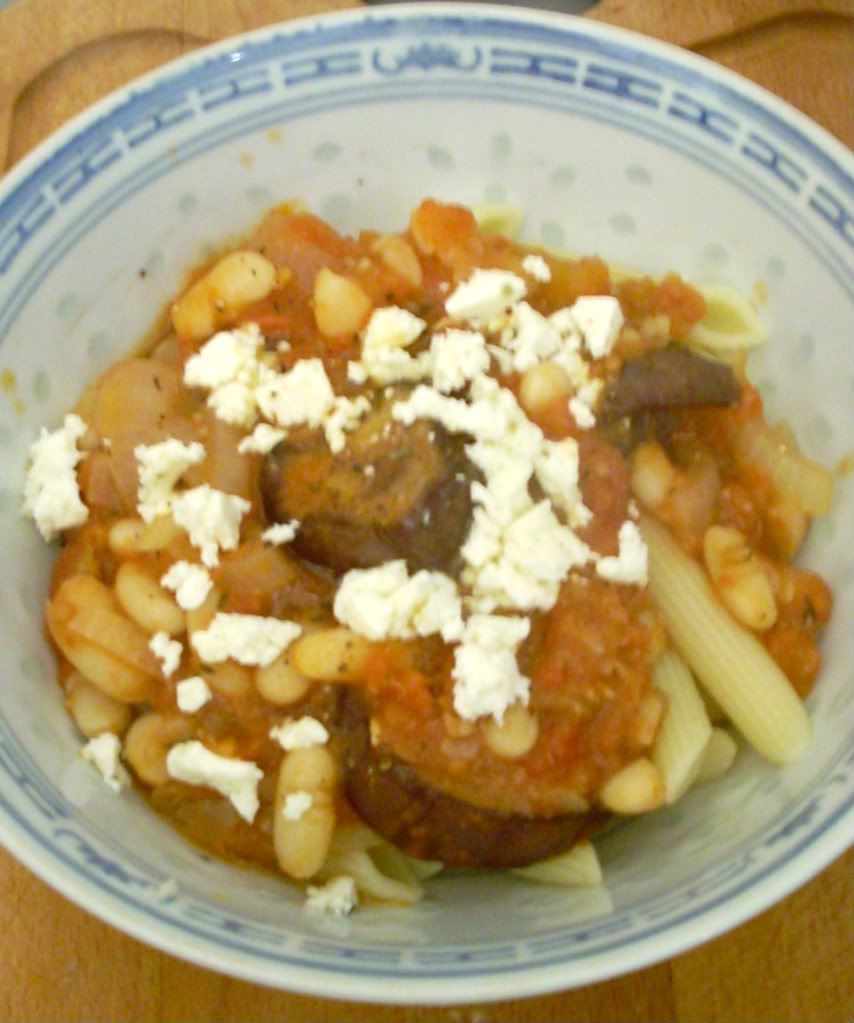
The first is that I added white beans to the sauce, because I have a little hang up about getting a good protein load (call it vegetarian paranoia). White beans are great with thyme and tomato so I figured it would work here - I added about three or four cups of cooked white beans, half kept whole and half pureed. The puree is a nice way to thicken the sauce quickly. I added the beans before I returned the eggplant rounds to the pan, to allow the beans to absorb more of the tomato flavour. I also used dried thyme instead of fresh thyme, which was a matter of necessity, and I'd love to try it with fresh thyme one day.

I think the trickiest part of the sauce is getting the eggplants right - I didn't use as much oil as Pim suggested because I forgot to check I had enough before I started, and wouldn't you know it, I'm actually running low on olive oil. So the eggplant tended to stick a bit (to be fair, Pim warns you about this.) But overall the recipe was pretty easy for me to execute even with my mind on my university assignment due the next day, and it tastes fantastic! The eggplant is really shown off in this dish - I don't think I've ever enjoyed the flavour of eggplant more, or appreciated how tender and almost sweet the flesh can be. I had this sauce on penne with some greek feta crumbled over the top.


lundi 20 octobre 2008

Sweet potato pikelets with spiced sauteed pears

My mother has been making sweet potato pikelets since I was a kid. Dusted with brown sugar and cinnamon, they're one of my favourite desserts or breakfasts. Sweet potato works so well with the cinnamon and the molassesy, dark sweetness of brown sugar. Although you couldn't really call them healthy with the amount of sugar I put on them, they do better than most desserts, and they far outstrip the humble plain pancake or pikelet in terms of taste anyway. I haven't seen my mom in eight months, and a week or so ago I decided I really needed these pikelets, so I skyped her ASAP for her recipe.

It's actually very easy - the recipe is loose and I made some modifications based on what I had on hand. The way I did it, a one-person serving is just 1 cup of mashed sweet potato, an egg, 2-3 tablespoons of flour, a pinch of baking powder and a pinch of salt. (If you wanted to serve these as a dessert to people with a serious sweet tooth you could add some brown sugar to the batter too.) I combine the egg with the sweet potato before adding the dry ingredients, then heat up a pan and make the pikelets. I like them done on a really hot pan so you get brown bits on the outside but the inside is still moist and dense. Dust them liberally with cinnamon and brown sugar - it is forbidden to eat theses any other way.

I had these with sauteed spiced pears on top. Sauteeing pears couldn't be easier, you just melt a little butter in a saucepan, add some brown sugar and stir until it's melted too, then throw in your peeled and sliced pears. I added the spices about midway through the sauteeing because I was using Babette's Seven Secrets mix of cardamom, coriander, anise, vanilla, szechuan pepper, tumeric and pepper and I didn't want it to burn. I'm pretty sure cinnamon would be fabulous too. Ideally the pear should be hard, which makes sauteed pears a good way to perk up fruit in winter (or when Franprix only has hard, lumpy pears, which is often). The pear I used was a little too close to ripe, but it held up well under sauteeing, and it was totally delicious anyway.

dimanche 12 octobre 2008

Die, Suzie Homemaker


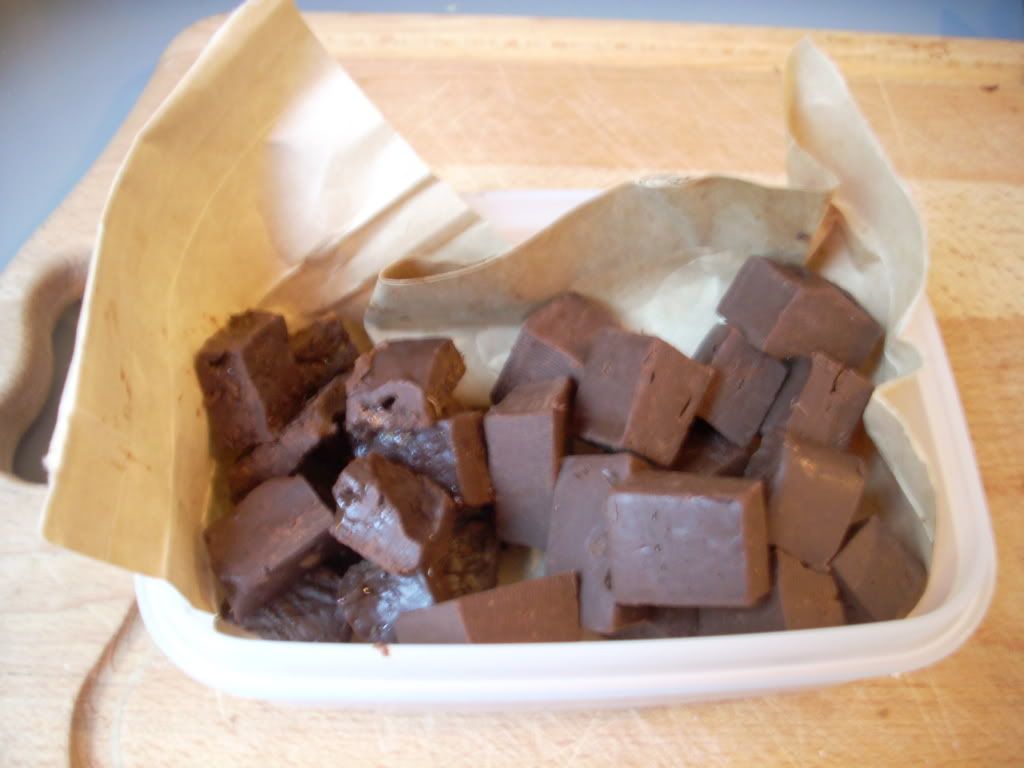
I know this chocolate fudge looks pretty Suzie Homemaker. My photography skills aren't helping either. And the basic recipe really is easy - it's condensed milk and melted dark chocolate combined in about a one to one ratio (measured in grams). First you melt the chocolate, either in the microwave, requiring obsessive checking and stirring, or on the stovetop in a bain marie, requiring obsessive set up and stirring. Then you add the condensed milk, combine pretty quickly as it starts to seize up fast, and pour it into a wide flat container so it can set in the fridge for 2 hours.

But this fudge can be amazing if you know how to work it. And though the fudge is going to reflect the quality of the chocolate you use, if you can only afford to use Nestle, you can still make yourself (and others) excited by this fudge. I know because I survive in France on a food budget calculated in Australian dollars. Ouch.

All you need is cinnamon and fresh ginger. You'll have to add the cinnamon to taste, but the ginger should generally be chopped up pretty fine as it is going to create a bit of moisture in the fudge even once it is set, and you don't want it to be too sticky. If you hate ginger, even the cinnamon on its own will taste great.

My favourite spice combination (so far) in fudge is actually Babette's Seven Secrets and cinnamon. I can't urge you to try this enough. That way if anyone ever asks you whether you think a mixture of cinnamon, pepper, vanilla, cardamom, coriander, anise, tumeric and szechuan pepper goes well with chocolate, you can tell them that it does. It really does. I like it both dusted on the outside - the spices have a yellowy tinge that looks great - or mixed in with the fudge itself.

I was concerned about how the spices would work with the chocolate, but it elevated the fudge beyond my expectations.